Teo Freytes finds familiarity in front of computer
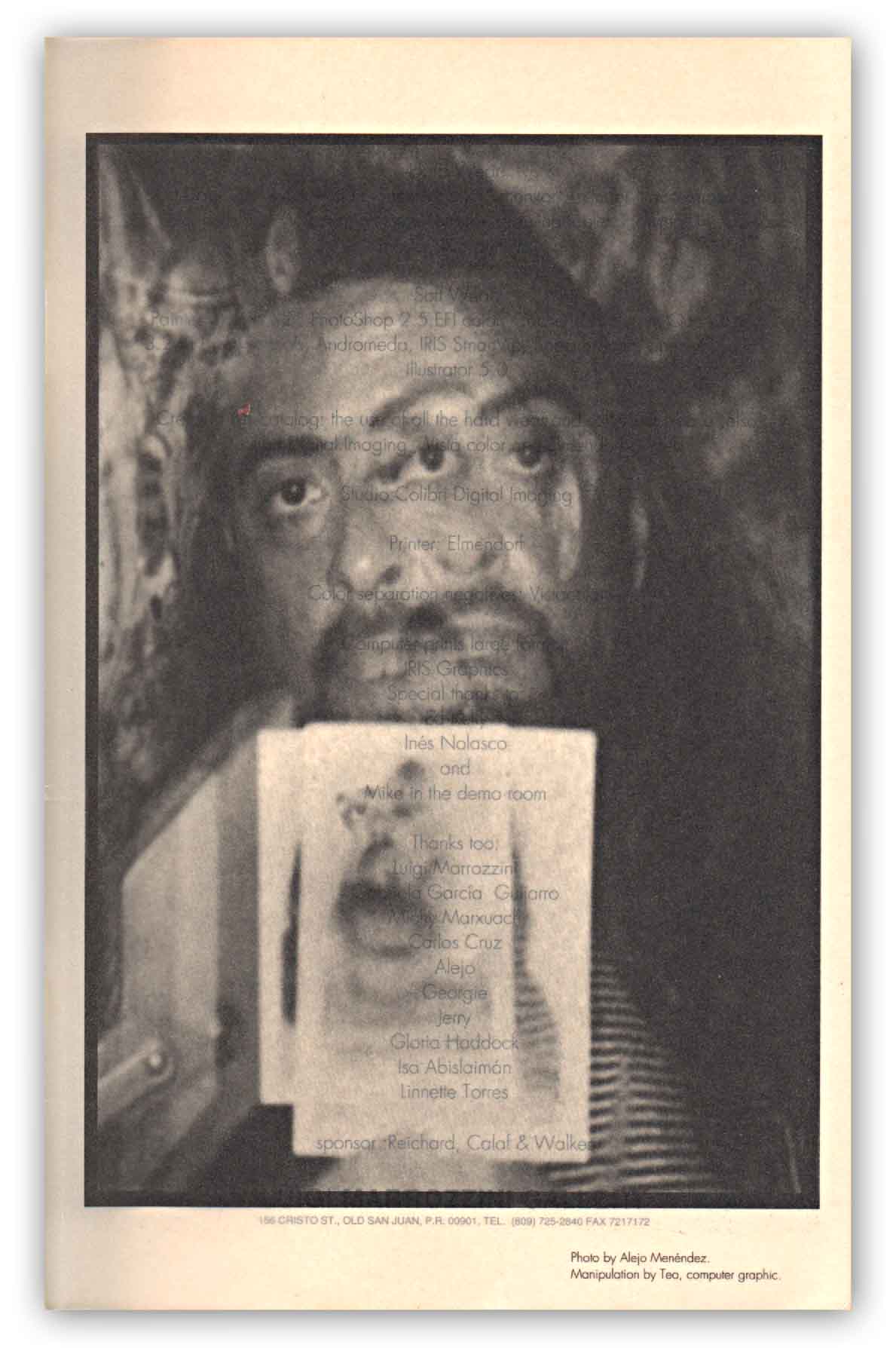
Graphic artist Teo Freytes uses mouse, not brush, to create artwork By Eneid Routte-Gomez
Redacción/ Escrito por Javier Martínez | Visit [a] Autogiro el giro del arte actual en Facebook
Teo Freytes finds familiarity in front of computer
Graphic artist Teo Freytes uses mouse, not brush, to create artwork By Eneid Routte-Gomez | Special writer | San Juan Star 1993
San Juan Star 1993 | Einstein and the theory of relativity, television and the facility to draw is part of the equation behind the computer art of Teo Freytes.
The other part is a liberal imagination. For the 40-year-old artist and system operator at Colibri Digital Imaging studio in Old San Juan the media is the computer.
A self-confessed child of the television age — the early 1950s — Freytes is at home with the computer as well as the canvas.
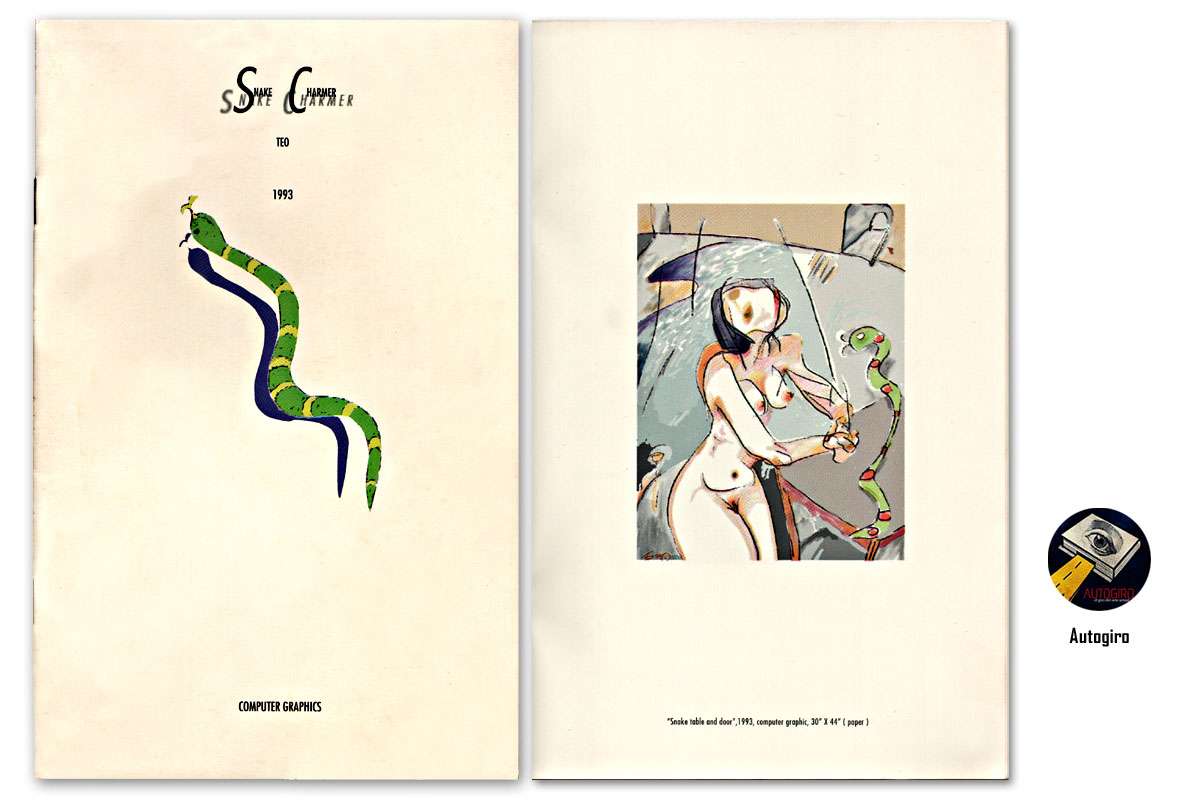
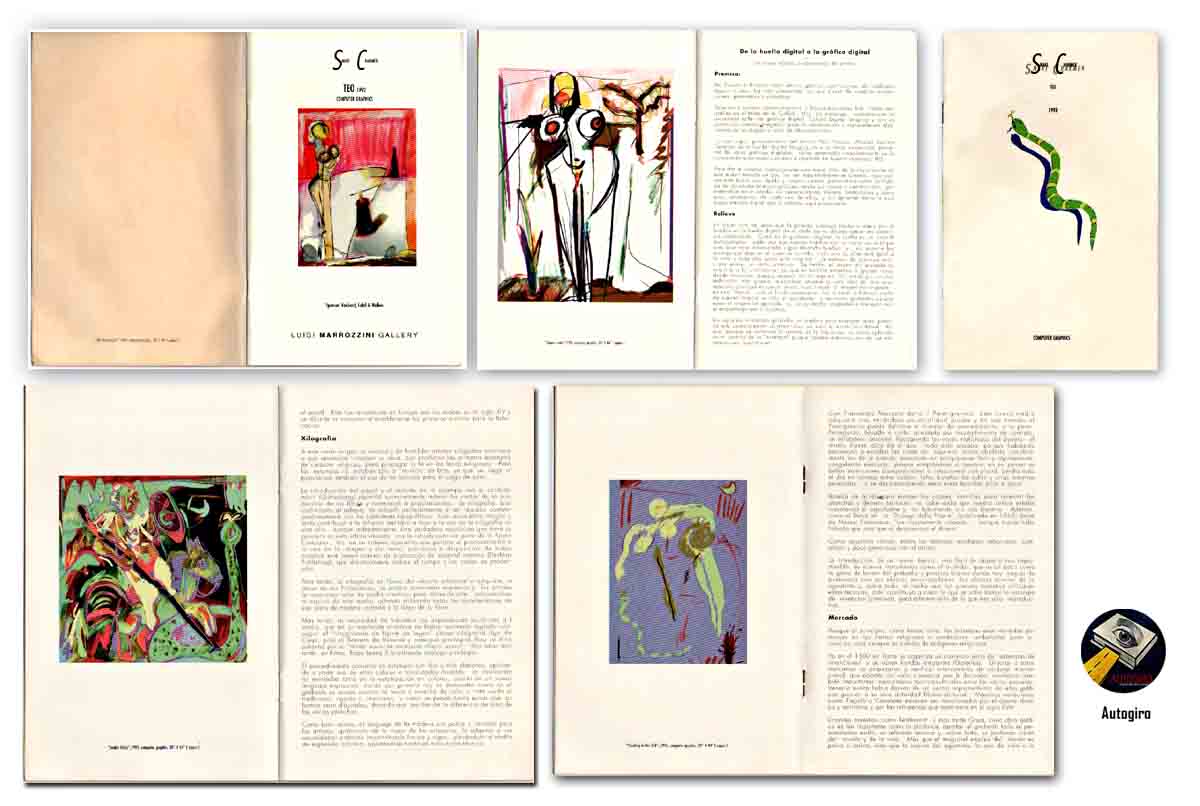
His exhibit, «Snake Charmer» at the Luigi Marrozzini Gallery (home of Colibri Digital Imaging) is a marriage of both.
In fact, he insists. only the uninitiated would quibble about computer art. The computer screen is today’s canvas.
«I think people think that computers do things”, he said. «Computers don’t do anything.» Just as a car needs a driver at the wheel, the computer needs a hand on the mouse.
«People are intrigued by computers,» Freytes says. “They think that the computer is doing the art. Well. it’s not. I’m the one who’s doing the art.» Freytes discovered the computer boom when he ran his own experimental gallery for six years. M.S.A. gallery had an open door policy: no artist would be turned away, every artist was welcome.
The gallery was also working to pay its own way through alternative advertising. Freytes discovered he could design, set type, even put out a handmade book practically In one fell swoop.
It was a fast process, one that allowed him to focus on the art itself. «I don’t have to wait for paint to dry”. Besides, working with computers reduced the toxic dangers of an artist’s workshop.
Tall, engaging, articulate, even though he admits to shyness. Freytes started drawing as a child, encouraged by his father. The talent was there, “It was something that came easily to me,» he said.
Art also gave him the freedom to create his own world. That world, however, was once invaded by an art teacher who wouldn’t let him paint freely.
“No,” she would say, he recalled, “an apple doesn’t look like that. It looks like this.» The experience was so traumatic for Freytes that he stopped painting for10 years.
Born In Mexico in 1953 — his father was studying medicine there — Freytes studied at Inter American University In San German and later at Miami Dade Community College in Florida. He calls himself a Miami-Rican because he studied there.
Ten years ago he returned to Puerto Rico and opened M.S.A. gallery with former wife Yrsa Davila. «I always wanted to make a gallery that accepted all artists” he explained

An artist always feels horrible when he goes to a gallery and asks that he be accepted. If you get rejected, it is a horrible experience. It’s hard to show yourself to someone and have them say “no” to you.»
The gallery, said art critic Ernesto Ruiz de la Mata, «was one of the most avant-garde ever … « in Puerto Rico.
Freytes has also made waves as a performance artist. He makes it a point to show up at gala art events as a piece of work. At the Ninth San Juan Biennial of Latin American and Caribbean Graphics he showed up as Mr. Puerto Rico.
When the local chapter of the International Art Critics Association gave its annual awards in 1991, Freytes appeared as the «blind critic»
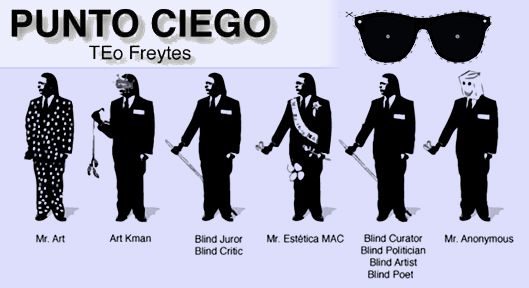
For Freytes, art is not cut in stone and he puts that philosophy into practice. There’s space in his mind, he says, for other points of view. He rejects elitist art and won’t impose his own taste on the works of others. What repels today, he believes, tomorrow compels. Art, he concludes, is an extension of being human.
«I think everybody is an artist,” he says. “If we all think of ourselves as artists I think we’d do things more carefully.”
Art is his vehicle toward self-discovery, he said. adding that artists Rafael (Sonny) Rivera Garcia and the late Felix Bonilla Norat were his guides. Einstein impressed on him the relativity of time.
«Art,» Freytes said. «reveals my self to me. It makes me do good things, to excel, discover things. Art is a liberating force, It keeps me active. That’s why we should all be artists.»
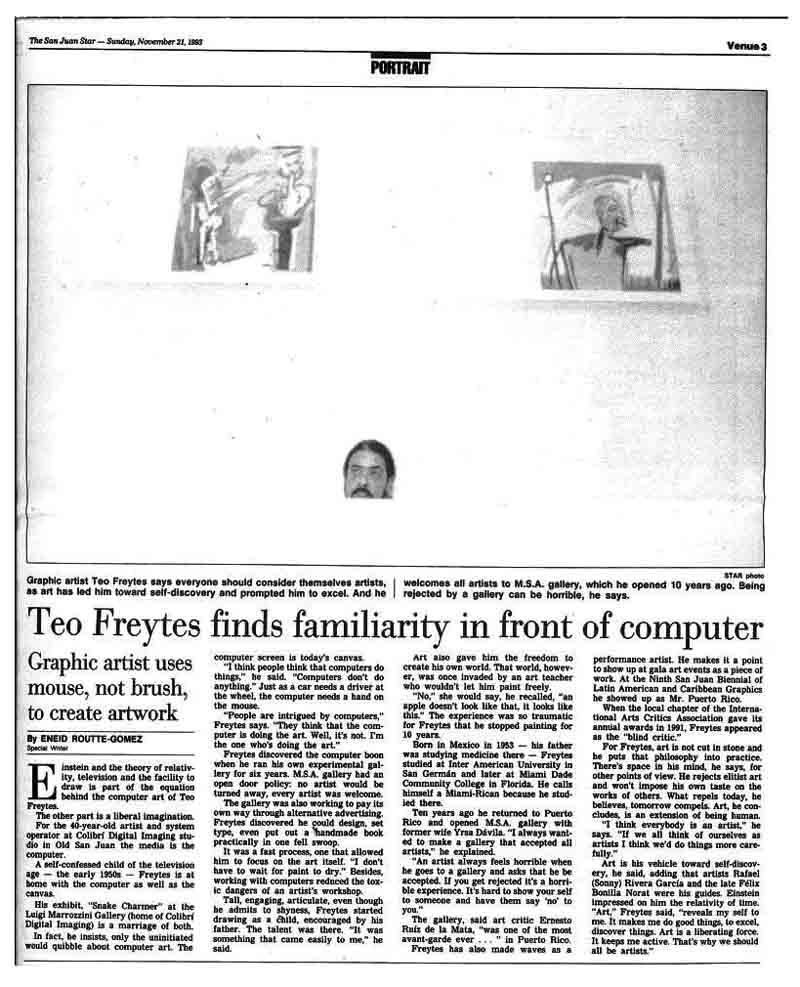
Cita: Graphic artist Teo Freytes says everyone should consider themselves artists, as art has led him toward self-discovery and prompted him to excel. And he welcomes all artists to M.S.A. gallery, which he opened 10 years ago. Being rejected by a gallery can be horrible, he says.

Teo Freytes encuentra familiaridad frente a la computadora
El artista gráfico Teo Freytes utiliza el ‘mouse», no el pincel, para crear sus obras. Por Eneid Routte-Gomez | Redactora especial | San Juan Star, Noviembre de 1993.
Einstein y la teoría de la relatividad, la televisión y la facilidad para dibujar forman parte de la ecuación que hay detrás del arte computacional de Teo Freytes.
El otro componente es una imaginación liberal. Para este artista y operador de sistemas de 40 años, que trabaja en el estudio Colibri Digital Imaging del Viejo San Juan, el medio de expresión es la computadora.
Freytes, quien se reconoce como un hijo de la era televisiva —la de principios de los años 50—, se siente tan cómodo frente a la computadora como ante el lienzo.
Su exposición «Snake Charmer», presentada en la Galería Luigi Marrozzini (sede de Colibri Digital Imaging), es una fusión de ambos mundos.

De hecho, él insiste: solo los no iniciados pondrían reparos al arte digital. La pantalla del ordenador es el lienzo de hoy en día.
«Creo que la gente piensa que los ordenadores hacen cosas —dijo—. Los ordenadores no hacen nada». Al igual que un coche necesita un conductor al volante, el ordenador necesita una mano sobre el ratón.
«La gente siente curiosidad por los ordenadores —dice Freytes—. Creen que es el ordenador el que crea el arte. Pues no es así. Soy yo quien crea el arte». Freytes descubrió el auge de la informática cuando dirigía su propia galería experimental, labor que desempeñó durante seis años. La galería M.S.A. tenía una política de puertas abiertas: no se rechazaba a ningún artista; todos eran bienvenidos.
La galería también buscaba financiarse mediante publicidad alternativa. Freytes descubrió que podía diseñar, componer el texto e incluso producir un libro artesanal prácticamente de una sola vez.
Era un proceso rápido que le permitía centrarse en el arte mismo. «No tengo que esperar a que se seque la pintura». Además, trabajar con ordenadores reducía los riesgos tóxicos propios del taller de un artista.
Alto, agradable y elocuente, a pesar de que admite ser tímido. Freytes comenzó a dibujar de niño, animado por su padre. El talento estaba ahí: «Era algo que me resultaba fácil», comentó.
El arte también le brindaba la libertad de crear su propio mundo. Sin embargo, ese mundo se vio invadido en una ocasión por una profesora de arte que no le permitía pintar con libertad.
«No», decía ella —según recordaba él—, «una manzana no se ve así. Se ve así». La experiencia resultó tan traumática para Freytes que dejó de pintar durante diez años.
Nacido en México en 1953 —donde su padre cursaba estudios de medicina—, Freytes estudió en la Universidad Interamericana de San Germán y, posteriormente, en el Miami Dade Community College, en Florida. Él mismo se define como «Miami-Rican» debido a que estudió allí.
Hace diez años regresó a Puerto Rico y abrió la galería M.S.A. junto a su exesposa, Yrsa Dávila. «Siempre quise crear una galería que acogiera a todos los artistas», explicó.
Un artista siempre se siente fatal cuando acude a una galería para pedir que lo acepten. Ser rechazado es una experiencia terrible. Es duro exponerse ante alguien y que te digan que no.
La galería, señaló el crítico de arte Ernesto Ruiz de la Mata, «fue una de las más vanguardistas que haya habido…» en Puerto Rico.
Freytes también ha causado impacto como artista de performance. Se asegura de asistir a eventos artísticos de gala convertido en una obra de arte en sí misma. En la Novena Bienal de San Juan del Grabado Latinoamericano y del Caribe, se presentó caracterizado como «Mr. Puerto Rico».
Cuando la sección local de la Asociación Internacional de Críticos de Arte entregó sus premios anuales en 1991, Freytes apareció como el «crítico ciego».
Para Freytes, el arte no es algo inmutable, y él lleva esa filosofía a la práctica. Según afirma, en su mente hay espacio para otros puntos de vista. Rechaza el arte elitista y no impone sus propios gustos a las obras de los demás. Cree que aquello que hoy provoca rechazo, mañana puede resultar fascinante. El arte, concluye, es una extensión de la condición humana.
«Creo que todo el mundo es artista», afirma. «Si todos nos consideráramos artistas, creo que haríamos las cosas con mayor esmero».
El arte es su vehículo hacia el autodescubrimiento, afirmó, añadiendo que los artistas Rafael (Sonny) Rivera García y el fallecido Félix Bonilla Norat fueron sus guías. Einstein le hizo comprender la relatividad del tiempo.
«El arte —dijo Freytes— me revela quién soy. Me impulsa a hacer cosas buenas, a superarme, a descubrir cosas. El arte es una fuerza liberadora; me mantiene activo. Por eso todos deberíamos ser artistas».
Cita: El artista gráfico Teo Freytes afirma que todos deberían considerarse artistas, ya que el arte lo ha conducido al autodescubrimiento y lo ha impulsado a superarse. Además, invita a todos los artistas a la galería M.S.A., que él mismo inauguró hace diez años. Según comenta, ser rechazado por una galería puede ser una experiencia terrible.
Se pueden incluir imágenes de perfiles en Facebook, la red y otros medios. son utilizadas para ampliar la experiencia del lector. Es una produccion y copyright de EDITORES CORTES PRECISOS © de Javier Martínez , artista multidisciplinario de Puerto Rico. Visita tambien CRONICA URBANA.COM